Settlement Repair
Differential foundation settlement — how it is confirmed, watched, and addressed.
San Diego County foundation settlement diagnostics — why a foundation settles, how to tell normal settling from a structural problem, and how independent local providers compare repair methods for your specific soil and settlement pattern.
Settlement RepairRequest ServiceWhen settlement is confirmed as active and structural, piers are one of the more commonly used methods to stop it — driven down to soil or bedrock stable enough to actually carry the load.
Ask if piering fits your situation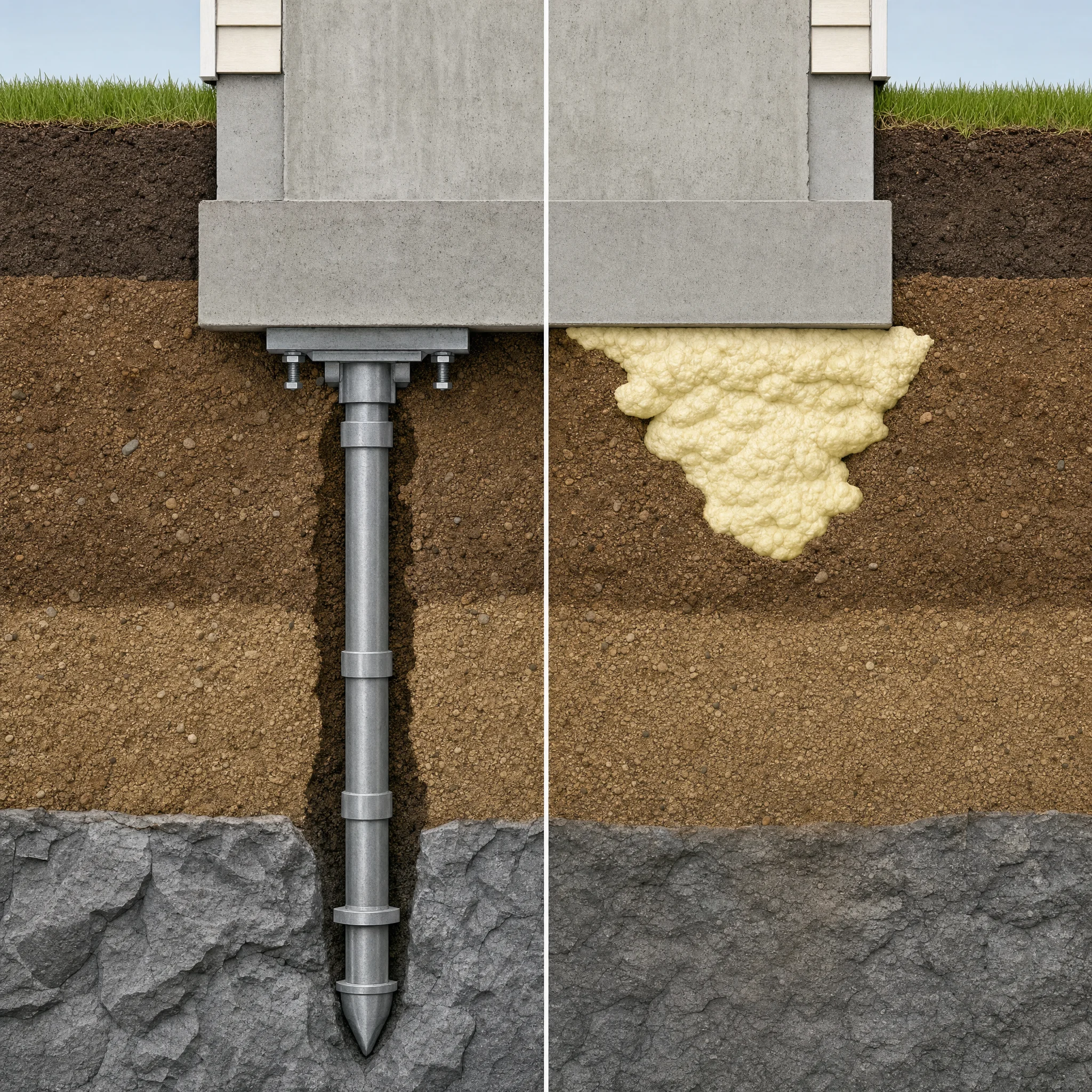
Steel push piers and helical piers both work on the same basic principle: transferring a foundation's load past the unstable soil near the surface — the soil that is actually causing the settlement — down to soil or bedrock stable enough to support it. Push piers are driven hydraulically using the structure's own weight as resistance; helical piers are mechanically screwed into the ground and can carry load more immediately. Once installed, the foundation can, in many cases, be lifted back toward its original position as part of the same work. Which pier type fits a given property depends on the soil profile, the load involved, and access — a determination made during an actual assessment, not from a general description. See steel piers vs. foam injection for how piering compares against the alternative approach for situations where it is not the best fit.
Push piers are driven hydraulically, using the structure's own weight as resistance, and are typically used once a structure has enough weight to provide that resistance. Helical piers are mechanically screwed into the ground and can support load more immediately, which can matter for lighter structures or additions. Which fits a specific property is a soil and structure determination, not a preference.
In many cases some amount of lift is possible as part of the piering work, but the amount and whether full releveling is advisable depends on the structure's age, how it was built, and how much movement has already occurred — determined during the assessment, not promised in advance.
No. It fits confirmed structural settlement where load-bearing soil is reachable at a workable depth. Some situations are better addressed with polyurethane foam injection instead — see the comparison for the conditions each method assumes.
Describe what has been confirmed so far — an inspection finding, a monitoring result, or just what you are seeing — and we can help you understand whether piering looks like a fit.
Request Service